
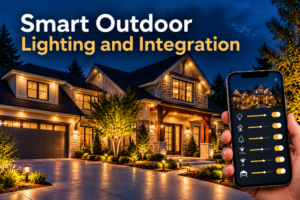
 Smart outdoor lighting can transform your home’s exterior while reducing energy costs and enhancing security. About 90 percent of outdoor fixtures are compatible with smart technology, which makes the upgrade simpler than you might think. Smart bulbs consume less energy, and you can schedule them to save more. This piece will walk you through planning your smart outdoor lighting system and choosing the best products for beginners. You’ll also learn how to install and configure your smart home outdoor lighting and maintain your smart landscape lighting system over time.
Why Integrate Smart Outdoor Lighting Into Your Home
Enhanced Security and Safety
Outdoor lighting serves as a powerful defense against intruders. Approximately 3,062 burglaries occur each day across the United States. More telling is that 66% of household burglaries happen at night when visibility is low. Motion-activated fixtures light up dark spaces the moment they detect movement. This startles potential intruders and removes shadows where they might hide.
A smart outdoor lighting system with motion sensors provides added protection. The sensors activate lights only when someone is present, which conserves energy while maintaining security. I can set up my fixtures to send alerts to my phone when activity is detected around my property. This gives me up-to-the-minute awareness of what’s happening outside.
Beyond deterring crime, smart landscape lighting eliminates safety hazards. Pathways, steps, and entryways that are well-lit prevent trips and falls for my family and guests navigating the property after dark. Dark driveways and uneven walkways no longer pose a risk when lights turn on as I approach.
Energy Efficiency and Cost Savings
The financial benefits of smart led outdoor lighting are substantial. Intelligent systems can achieve energy savings between 35% and 70% on total lighting costs. According to the Italian Association of Lighting Manufacturers, smart lighting can cut energy consumption by 50%.
LEDs combined with smart controls reduce energy usage by up to 80% compared to traditional lighting. A 10-watt LED bulb emits the same light as a 60-watt incandescent bulb. LEDs last 25,000 to 50,000 hours. This means fewer replacements and lower maintenance costs over time.
Motion sensors further reduce consumption by 20% to 40%. These sensors detect and regulate luminous flux based on the environment and people present. Remote control systems that fine-tune light levels according to context cut consumption by up to 25%. Scheduling features prevent lights from running longer than needed. Geo-fencing turns off lights based on my smartphone’s location.
Convenience and Remote Control
A smart outdoor lighting controller eliminates the need to switch lights on and off by hand. I can adjust brightness, schedule operations, and change light colors through an app on my smartphone or tablet. Voice commands through Amazon Alexa or Google Assistant make control even simpler.
Geo-fencing technology tracks my phone’s location and adjusts lighting as I come and go. If I forget to turn off lights before leaving, I can switch them off remotely through my mobile device. Smart systems integrate naturally with other devices like thermostats and security cameras. This enables coordinated responses. Lights can turn on when motion is detected by security cameras, creating synchronized protection.
Curb Appeal and Property Value
Smart outdoor landscape lighting boosts the esthetic appeal of my property while delivering measurable returns. Lighting professionals report that well-executed outdoor lighting can add up to 20% to the perceived value of a home. The National Association of REALTORS notes that homeowners can recover up to 59% of their landscape lighting installation cost when selling.
Studies show that professional outdoor lighting can make a home 30% more valuable to potential buyers. Strategic placement transforms yards into stunning visual displays after dark. It highlights architectural features, gardens, and pathways. This combination of beauty and functionality makes properties feel more polished and inviting, which translates to higher market appeal and resale value.
Planning Your Smart Landscape Lighting System
Before purchasing a single fixture, I need a clear plan that addresses my property’s unique layout and requirements. A structured approach prevents common mistakes like underpowering zones or creating dead spots along walkways.
Map Out Your Outdoor Spaces
Dividing my property into distinct zones before selecting fixtures is the most effective first step. Each zone gets assigned a purpose, and this clarifies every subsequent decision from fixture type to wiring layout.
Most residential properties benefit from this practical zone breakdown:
-
- Front yard and entry: Path lights, wall sconces and uplights on architectural features serve functional and curb-appeal purposes
- Driveway and walkways: Safety-focused lighting with consistent, low-glare path lights that guide movement without blinding visitors
- Patio and outdoor living areas: Atmospheric lighting with softer, layered light that creates comfort
- Garden beds and specimen trees: Accent-driven uplights and spotlights that draw attention to focal points like mature oaks or sculptural shrubs
- Perimeter and back fence lines: Security-oriented broader flood coverage that deters intrusion
I sketch my zone map on a printed satellite image of my property and mark each zone’s purpose. I also note the distance from my planned transformer location. This single step prevents the most common DIY wiring mistakes.
Determine Your Lighting Goals
I identify why I need outdoor lighting before making product selections. Security priorities call for motion sensor lights that illuminate when detecting movement. Color-changing lights set the desired mood when creating ambiance during gatherings. Pathway lighting prevents trips and falls by illuminating walkways.
I select the objectives that appeal most and prioritize them by importance. This helps me design a smart landscape lighting system that fits my vision and budget.
Set Your Budget
Landscape lighting professionals recommend setting aside 10 to 20 percent of the entire landscape project budget for outdoor lighting. A baseline of USD 16.00 per square foot (including fixtures and labor) provides a realistic starting point for standalone lighting projects.
I add a 10 to 15 percent contingency to my total budget for unexpected costs like wiring issues or minor repairs. My budget gets maxed out sometimes, so I add pipe, wire and conduits during the construction phase as a proactive cost-saving measure. Updating these elements months or years later costs substantially more.
Many homeowners find that a small start works well. I can illuminate one area first, the backyard for security or pathways for safety. Homeowners who start with one illuminated space expand their system eventually, and nearly 100 percent do so.
Check Your Home Automation Compatibility
I verify that my chosen smart outdoor lighting system merges with my existing smart home ecosystem. Compatibility with platforms like Apple HomeKit, Samsung SmartThings, Amazon Alexa or Google Assistant allows centralized control among other connected devices.
App control lets me adjust settings from anywhere. Lights that sync with my home automation system can be controlled with other smart devices and create a cohesive smart home outdoor lighting experience.
Why It’s Better to Hire an Outdoor Lighting Designer Than Try to Do It Yourself
Professional Design Creates a Completely Different Look
Outdoor lighting design is about more than installing lights around your property. A professional considers your home’s architecture, landscaping, focal points, viewing angles, shadows, and how each layer of light works together to create a polished nighttime appearance.
The Right Fixtures Go in the Right Places
One of the biggest differences between DIY and professional lighting is placement. An outdoor lighting designer knows where fixtures should be positioned, how far apart they should be, and which direction they should face to achieve the desired effect.
You Avoid the “Too Many Lights” Problem
More lighting doesn’t necessarily mean better lighting. Professional designers use contrast between light and darkness to create depth and visual interest without making your property look overly bright.
Professional Lighting Helps Eliminate Glare
A poorly positioned fixture can shine directly into windows, seating areas, neighboring properties, or people’s eyes. Professional design focuses on illuminating the intended surface while keeping the light source itself as unobtrusive as possible.
Your Home and Landscaping Are Designed Together
Trees, gardens, stonework, architectural details, entrances, patios, and other features all require different lighting techniques. A designer creates a cohesive plan rather than treating each fixture as an individual light.
You Get the Right Fixture for Each Application
Uplights, downlights, path lights, step lights, wall lights, hardscape lights, spotlights, and specialty fixtures each serve different purposes. A designer selects fixtures based on the effect and function needed in each location.
Color Temperature and Brightness Matter
The wrong color temperature can dramatically change how brick, stone, siding, plants, and outdoor living spaces appear at night. A professional can coordinate color temperature and brightness to create a comfortable, consistent look.
Safety Is Designed Into the System
Steps, pathways, driveways, entrances, elevation changes, and dark areas need adequate visibility. Professional outdoor lighting can address these areas while integrating safety lighting naturally into the overall design.
The System Is Designed to Grow With You
A well-planned lighting system can account for future landscaping, outdoor living improvements, additional lighting zones, and smart controls. That can make future upgrades easier than continually adding disconnected fixtures.
Smart Lighting Is More Useful When It’s Properly Planned
Timers, zones, dimming, scheduling, automation, and smart-home integration can give homeowners much greater control. A designer can determine which areas should operate together and how the system should function throughout the evening.
Professional-Grade Equipment Is Built for Outdoor Use
Quality outdoor lighting systems are designed to withstand weather, moisture, temperature changes, and years of exposure. Professional installation also addresses connections, transformers, wiring, and other components that affect long-term reliability.
You’re Paying for the Finished Effect, Not Just the Lights
The biggest advantage of hiring an outdoor lighting designer is that you’re not simply buying fixtures—you’re investing in how your entire property looks and functions after sunset. A professionally designed system can bring together beauty, ambiance, safety, security, and convenience in one cohesive plan.
Installing and Configuring Your Smart Outdoor Lighting
Wired vs Wireless Installation
Wired systems use physical connections between switches, sensors and fixtures. They deliver consistent communication with less signal interference. These setups work best for new construction where you can install control wiring during the original build. Existing buildings require additional planning and infrastructure access, which makes modernizing them more labor-intensive.
Wireless smart outdoor lighting systems communicate through radio frequency. No dedicated control wiring between components is needed. The flexibility advantage is substantial. You can add devices without modifying existing wiring. Wireless controls reduce labor and material costs while increasing system scalability. Wireless installation proves simpler because you install fixtures and wall switches without pulling control wires. Wireless systems allow quick installations even when modernizing with minimal disruption.
Connecting to Your Smart Home Hub
Gateway placement requires specific positioning. Place the gateway indoors within 20 feet of your WiFi router and 60 feet of the closest smart fixture. The AMP iQ system requires installing the Gateway within 20 feet of a Wi-Fi router, then finding all devices through the app.
Smart bulbs require a 2.4GHz WiFi network and an always-on power supply. Connect your phone to the same WiFi network the gateway will use and turn Bluetooth on. The pairing process displays all powered, compatible devices in the app. Devices ready to pair show a pulsing ring in the app and a flashing white light on the fixture.
Setting Up Zones and Groups
Zones define physical areas of the property such as Front Yard, Backyard, Pool or Trees. Groups represent sets of fixtures you control together, often within a zone, like all tree uplights or pathway lights. Scenes save lighting configurations that include fixture selection, brightness levels, color and white CCTs.
Devices appear in the app when you onboard them. Tap each device to associate it with your account, then assign them to zones and groups. Name devices based on their location or function for easier service and control. A single fixture can be part of multiple groups, which allows flexible control options. You can move fixtures between zones at any time through the app.
Creating Lighting Scenes
Scenes establish how lighting looks and operates across selected fixtures. Create custom lighting scenes to set the perfect ambiance for occasions like relaxing evenings or outdoor gatherings. Preset scenes allow you to adjust multiple lights to suit your mood or activity. Scheduling automations based on motion detection, sunrise and sunset will keep your outdoor area well-lit when needed and conserve energy otherwise.
Maintaining and Troubleshooting Your System
Common Setup Issues and Solutions
Connectivity problems rank among the most frequent issues with smart home outdoor lighting. Lights sometimes stop responding. I check my Wi-Fi connection first and verify fixtures remain within range of my router or bridge. A restart of the app or my smartphone often resolves app control problems. Dim or flickering lights usually indicate loose connections or low power. I inspect all connections and tighten any loose wiring, then confirm my power source delivers enough voltage.
My whole smart outdoor lighting system sometimes goes dark. I check the 120V power source to see whether the GFI switch or breaker tripped. Some fixtures go out and may indicate burned bulbs that need replacement or cut wires that need repair with wire connectors. Photocells and timers need to be cleaned and their schedules verified. I cap the photocell while testing, then remove the cap after maintenance ends.
Regular Maintenance Tips
I clean my smart led outdoor lighting fixtures every three months using a soft, dry cloth. Accumulated dirt dims brightness and raises corrosion risks. I inspect wiring and connections quarterly and look for frayed wires, loose fittings, or corrosion. Weather exposure and temperature fluctuations loosen connections over time.
Fixtures with batteries or solar power need regular battery checks and replacements when they no longer hold charges.
Expanding Your System Over Time
I add fixtures to my smart landscape lighting system gradually and make sure my transformer handles the increased wattage load. I test after each addition to confirm the problem was addressed accurately.
Smart outdoor lighting delivers measurable returns through better security and lower energy bills. The options might seem overwhelming at first, but you can start small with a single zone and expand over time. Follow the planning steps outlined here. You’ll avoid common installation mistakes and create a system that fits your budget and needs. Choose products compatible with your existing smart home setup and take care of regular maintenance. Your smart landscape lighting will serve you for years. Start with clear goals and a solid plan. Revolutionizing your outdoor spaces is simpler than you think.
FAQs
Q1. How much can I save on energy costs with smart outdoor lighting? Smart outdoor lighting can reduce your total lighting costs by 35% to 70%. When you combine LED bulbs with smart controls, you can achieve energy savings of up to 80% compared to traditional lighting. Motion sensors alone can cut consumption by an additional 20% to 40% by ensuring lights only operate when needed.
Q2. Will smart outdoor lighting increase my home’s value? Yes, professional outdoor lighting can add up to 20% to your home’s perceived value. According to the National Association of REALTORS, homeowners can recover up to 59% of their landscape lighting installation cost when selling. Well-executed outdoor lighting can make a home 30% more valuable to potential buyers by enhancing curb appeal and functionality.
Q3. Do I need a hub to use smart outdoor lighting? Not always. Some smart bulbs like the LIFX Color BR30 and GE Cync PAR38 connect directly through Wi-Fi or Bluetooth without requiring a separate hub. However, more advanced systems like Philips Hue use a hub for greater range and features. Hub-free options work well for beginners, while hub-based systems offer better integration and control for larger setups.
Q4. Should I choose wired or wireless smart outdoor lighting? Wireless systems are generally easier to install, especially for retrofitting existing homes, as they don’t require running control wires between components. They’re more flexible and cost-effective for most homeowners. Wired systems offer more consistent communication with less interference but work best for new construction where wiring can be installed during the initial build.
Q5. How do I troubleshoot smart outdoor lights that stop responding? First, check your Wi-Fi connection and verify that fixtures are within range of your router or bridge. Restart your smartphone app and the device itself. If lights are dim or flickering, inspect all connections for loose wiring and confirm your power source provides adequate voltage. For complete system failures, check whether the GFI switch or breaker has tripped.
We Provide Outdoor Lighting Design Services
When you partner with our lighting design team, you’re not just getting fixtures installed—you’re investing in a custom lighting narrative that transforms your property into a stunning nighttime showcase. Our designers work closely with you to understand your vision, then craft a lighting plan that highlights your home’s best architectural features while creating the perfect ambiance for your outdoor living spaces. You’ll see how strategic placement of uplighting, moonlighting, and accent fixtures can turn ordinary landscaping into an extraordinary visual experience that makes your neighbors stop and stare.
> Learn More
Contact Us (513-485-1912) for a Free Consultation!
—
 About Elegant Outdoor Lighting & Design
 About Elegant Outdoor Lighting & Design
Elegant Outdoor Lighting & Design provides custom landscape and architectural lighting for homeowners who want to enjoy their property after dark. We design and install outdoor lighting systems that enhance the architecture of your home, while illuminating trees, pathways, patios, pools and outdoor living spaces. Our approach focuses on balance, warmth, and thoughtful fixture placement to create inviting nighttime environments. From personalized design consultations to professional installation and ongoing maintenance, we deliver outdoor lighting solutions tailored to fit your home and your vision.
> Learn More